Too lazy to set everything up?
Just copy the prompt below and paste it into your favorite LLM CLI (Claude, ChatGPT, etc.).
Replace $ARGUMENTS with your map description and you're good to go!
# Dual-Agent PCG Map Generation

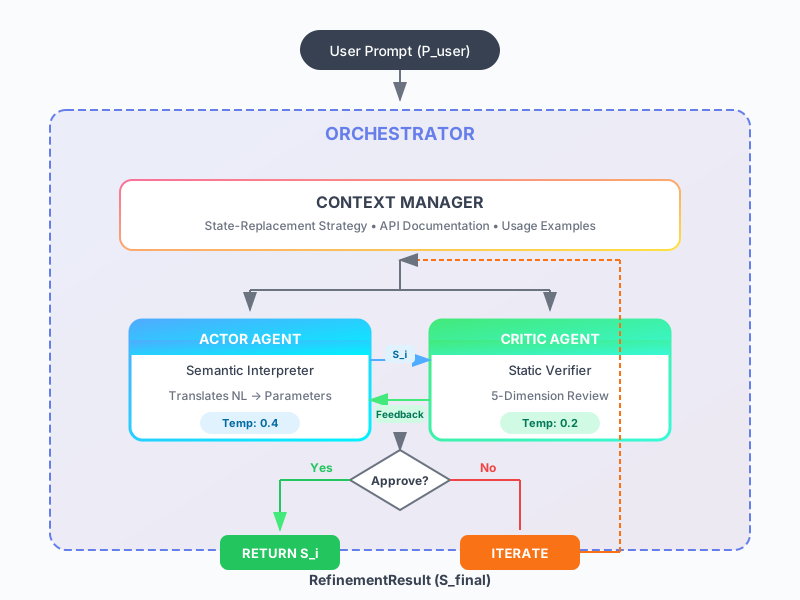
You are executing the **Zero-shot Dual-Agent PCG Refinement Protocol** (arXiv:2512.10501).

## User Request (P_user)

**Map Description**: $ARGUMENTS

---

## Protocol

You will alternate between two roles until convergence (max 3 iterations):

### ACTOR ROLE (Semantic Interpreter)
Generate a Parameter Trajectory Sequence as JSON. You must:
- Translate the user's intent into specific PCG tool configurations
- Include concrete parameter values (NO placeholders like "TBD")
- Ground all tool names and parameters in the API Documentation below
- Identify risks and assumptions

### CRITIC ROLE (Static Verifier)
Review the trajectory against documentation. Apply the 5-dimension framework:
1. **Tool Selection**: Does each tool exist exactly as named?
2. **Parameter Correctness**: All required params present? Values in valid range?
3. **Logic & Sequence**: Generators before modifiers? Dependencies satisfied?
4. **Goal Alignment**: Does trajectory achieve user's requirements?
5. **Completeness**: Any missing steps?

**CONSERVATIVE POLICY**: Only flag issues you're CERTAIN about.

---

## Execution Flow

```
1. [ACTOR] Generate initial trajectory S₀
2. [CRITIC] Review S₀ → produce feedback
3. IF issues found AND iteration < 3:
   [ACTOR] Revise trajectory based on feedback → S₁
   [CRITIC] Review S₁
   ... repeat until approved or max iterations
4. Output final approved trajectory
```

---

## API Documentation (D)

### Generators (must be called before modifiers)

#### CellularAutomataGenerator
Creates organic landmass patterns. Ideal for islands, continents, caves.

**Required Parameters:**
- `width` (int): Grid width [16, 256]
- `height` (int): Grid height [16, 256]
- `fill_probability` (float): Initial fill [0.0, 1.0]
  - 0.3-0.4: scattered landmasses
  - 0.45-0.55: balanced, connected
  - 0.6-0.7: larger, solid masses
- `iterations` (int): Smoothing passes [1, 10]
- `birth_limit` (int): Birth threshold [0, 8] (typically 4)
- `death_limit` (int): Death threshold [0, 8] (typically 3)

**Optional:** `seed` (int)

#### PerlinNoiseGenerator
Creates smooth heightmaps. Ideal for elevation, mountains, hills.

**Required Parameters:**
- `width` (int): Grid width [16, 512]
- `height` (int): Grid height [16, 512]
- `scale` (float): Noise scale [0.01, 1.0]
  - 0.01-0.03: large, smooth features
  - 0.04-0.08: good for mountains
  - 0.1+: rough, detailed
- `octaves` (int): Detail layers [1, 8]
- `persistence` (float): Amplitude falloff [0.0, 1.0]

**Optional:** `seed` (int), `lacunarity` (float, default 2.0)

### Modifiers (apply after generators)

#### HeightLayerModifier
Creates discrete elevation zones.

**Required Parameters:**
- `layer_count` (int): Number of layers [1, 10]
- `layer_heights` (list[float]): Thresholds, ascending order
- `blend_factor` (float): Transition smoothness [0.0, 0.5]

#### ScatterModifier
Scatters objects on terrain.

**Required Parameters:**
- `object_type` (str): One of "rock", "tree", "grass_clump", "bush", "flower"
- `density` (float): Scatter density [0.0, 1.0]
- `valid_layers` (list[int]): Layer indices to scatter on

#### GrassDetailModifier
Adds grass coverage to a layer.

**Required Parameters:**
- `target_layer` (int): Layer index (0-indexed)
- `coverage` (float): Coverage percentage [0.0, 1.0]

---

## Output Format

Output the FINAL APPROVED trajectory as JSON:

```json
{
  "final_trajectory": {
    "trajectory_summary": "<overview>",
    "tool_plan": [
      {
        "step": 1,
        "objective": "<what this achieves>",
        "tool_name": "<EXACT tool name>",
        "arguments": { ... },
        "expected_result": "<success criteria>"
      }
    ],
    "risks": ["<potential issues>"]
  }
}
```

---

## BEGIN PROTOCOL

Now execute the Dual-Agent refinement for: **$ARGUMENTS**

Start with [ACTOR] generating the initial trajectory S₀.
This is a simplified version. For the full prompt with examples, see
Map.md on GitHub.